
Q1 2026: More Deals, Less Capital
Dealmaking Splits: More Deals, Less Capital
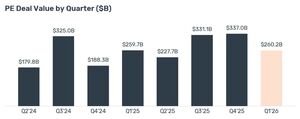
Q4 2025 closed at $337 billion in deal value, the strongest quarter of the year and a reminder that capital was still willing to move at scale. Q1 2026 told a different story: PE dealmakers closed 2,415 announced and estimated transactions, up 7.3% quarter over quarter and 6.7% year over year, while aggregate deal value fell to $260.2 billion, a 22.8% quarter over quarter pullback, even as it came in essentially flat against Q1 2025's $259.7 billion. More deals, less capital, is the signal here: dealmakers shifted down market, spreading activity across a wider set of smaller transactions rather than committing to the scale seen at the end of 2025. The divergence is sequential rather than a year over year trend, but the composition of the quarter, and the forces shaping it, still warrant attention.
The HALO Trade Takes Hold
The dominant theme of the quarter is risk repricing. Recession odds implied by prediction markets averaged 23.5% through the first two months of Q1, then spiked to 37% following the onset of the Iran conflict and held around 35% in March. Energy prices transmitted quickly through the economy, with gasoline up 27.2% year over year and jet fuel up 78.8%, while the Federal Reserve's March projections shifted rate expectations higher for longer. Investors have rotated toward what Ritholtz Wealth Management's Josh Brown termed the HALO trade, heavy assets, low obsolescence: transmission grids, pipelines, utilities, and long cycle industrial capacity that are costly to replicate and largely indifferent to how quickly AI reshapes software. The quarter's largest deal, AES at $33.4 billion, sits squarely in that category. Software felt the opposite pull: the sector PitchBook now calls the SaaS pocalypse saw its share of PE deal value compress sharply, continuing the reassessment that has been building since late 2025.
Exits Cool From a Strong Q4
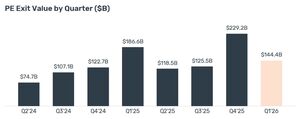
US PE exit activity pulled back in Q1 2026 as the same headwinds made it difficult to sustain the momentum built through the second half of 2025. With an estimated 373 exits for an aggregate of $144.4 billion, exit activity declined 37.0% in value and 13.1% in count quarter over quarter, with exit value down 22.6% year over year. Zooming out, the decline owes more to Q4 2025's outsized strength (itself the strongest exit quarter since 2021) than to any fresh deterioration in the exit environment: Q1 2026 exit values remain well above pre pandemic averages, and exit count sits 7.3% above that historical baseline. Mega exits, transactions of one billion dollars or more, accounted for $100.9 billion of the quarter's exit value, roughly 70% of the total, evidence that premium assets can still clear at scale even as the broader PE backed inventory, now 13,325 companies deep, continues to face a persistent valuation gap. The public listing window told a similar story of quality over quantity: five IPOs completed in the first quarter before activity stalled by late February.
Fundraising Holds Its Muted Pace
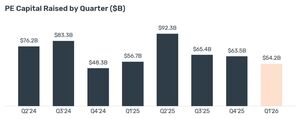
US PE fundraising saw 84 funds hold final closes through the start of the year, totaling $54.2 billion, a pace consistent with 2025's subdued full year total of $286.0 billion across 406 funds. Capital concentration remains the defining feature of the market: the ten largest funds raised through Q1 accounted for $34.5 billion, or 63.7% of total capital raised, continuing a multi year trend toward fewer, larger managers. Distribution rates, the pace at which GPs return capital to LPs, sit at 16.0%, well below the 24.2% historical average, leaving LPs with less to recycle into new commitments. A quieter but consequential shift continues alongside all of this: semi liquid, or evergreen, PE structures reached $57.6 billion in US net assets by the end of 2025, more than double their level two years earlier, a sign that the industry's capital formation model is changing even as traditional drawdown fundraising stays muted.
Conclusion: Repricing, Not Retreat
Q1 2026 is best read as a market repricing risk rather than retreating from it. Capital rotated toward hard, durable assets and away from the software exposure that defined the last PE cycle, while dealmakers spread activity across more, smaller transactions instead of committing to size. Exits and fundraising both cooled from a strong finish to 2025, but neither shows the kind of structural break that would signal a deeper downturn. The Iran conflict, a hawkish Fed, and a widening buyer seller valuation gap are the forces to watch heading into Q2.
Key questions for Q2:
- Does the HALO trade keep gaining share of deal value, or was Q1 a one quarter reaction to the Iran conflict?
- Can the exit market sustain its post pandemic strength if the valuation gap between buyers and sellers keeps widening?
- Does semi liquid and evergreen fund growth start to meaningfully substitute for traditional drawdown fundraising, or stay a parallel track?
At V17 Advisors, we help PE managers navigate exactly this kind of repricing environment, from fund structuring questions raised by the shift toward evergreen vehicles to the compliance and reporting discipline LPs expect when capital gets more selective.
Get in touch to talk through how Q1's shift affects your fund's positioning.