
Q1 2026: Four Deals, One Record Quarter
A Record Quarter, Concentrated in Four Deals
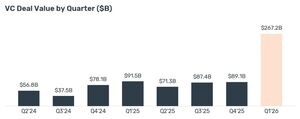
Q4 2025 already showed deal value holding above pre-pandemic levels; Q1 2026 blew past it entirely. VC firms deployed $267.2 billion in the quarter, the second highest full year equivalent total on record (trailing only 2021 and 2025), across an estimated 4,594 deals. But the concentration behind that number is extreme even by 2025's standards: four deals above $15 billion were completed in the quarter alone, including OpenAI's $122 billion financing and xAI's merger with SpaceX, the largest VC backed exit of a US company ever recorded. Strip out the top five deals and Q1's deal value falls 73.2%. The cost of participating at every stage is also climbing fast: the median Series A pre-money valuation reached $62 million, nearly triple the $21 million recorded in 2020, while the median Series C pre-money valuation surged to $579 million from $167.2 million over the same period.
SpaceX's $250 Billion Move Rewrites the Exit Ledger
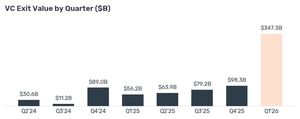
Exit value hit $347.3 billion in Q1, a new quarterly high and already the second highest full year total in VC history with three quarters still to go. A single transaction accounts for 72% of that figure: SpaceX's $250 billion acquisition of xAI, a deal that, with both companies under Elon Musk's control, reads less like a traditional exit than a consolidation of affiliated assets, muting its practical significance for the broader liquidity picture. Exclude it, and the underlying exit environment sits at $97.3 billion, still the strongest quarter since Q4 2021. The concentration problem runs deeper still: 86.8% of Q1 acquisitions carried undisclosed valuations, implying significant markdowns for many sellers. Elsewhere, Google closed its $32 billion acquisition of cybersecurity company Wiz (the largest corporate acquisition of a VC backed company on record), while Marvell Technology's $6 billion purchase of Celestial AI and Palo Alto Networks' $3.4 billion acquisition of Chronosphere rounded out a busy quarter for AI infrastructure consolidation.
Fund Formation Snaps Back, Concentration Persists
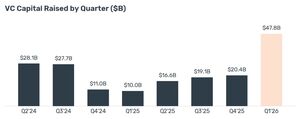
Q4 2025 closed the year at the fewest funds closing in a decade; Q1 2026 reversed course sharply on the surface. $47.8 billion was raised across 172 funds in the quarter, already 72% of all of 2025's full-year total in a single quarter. But the recovery is narrow: six managers (Andreessen Horowitz, Thrive Capital, Founders Fund, Battery Ventures, Kleiner Perkins, and Lux Capital) together raised $36.4 billion, or 76.2% of the quarter's total capital, meaning every other fund that closed during the quarter split less than a quarter of the capital raised. This is an intensification of a trend that built steadily through 2025, not a new phenomenon, but Q1's numbers make the concentration harder to ignore.
The Price of Admission Keeps Rising
Beneath the headline concentration, deal economics are shifting structurally across every stage. The median Series A deal size climbed to $19.6 million from $7.5 million since 2020, while the median Series C deal size rose to $75 million from $35 million over the same period. The gap between median and average deal sizes is widening too: at Series A, the Q1 2026 median of $19.6 million sits well below the average of $39.6 million, and at Series C, the $75 million median sits well below the $124.6 million average, reflecting an increasingly bifurcated market where a handful of outsized rounds pull the average far above what a typical company actually raises. Half of all early-stage deals now exceed $10 million, the highest share of large early-stage deals in the past decade.
Conclusion: Concentration Becomes the Default, Not the Exception
Q1 2026 didn't introduce a new dynamic to venture capital: it intensified every one already in motion. Deal value, exit value, and fund formation all showed real recoveries on paper, and all three recoveries trace back to a startlingly small number of companies and managers. That's not necessarily unhealthy: real capital is being deployed into real technological progress, and even concentrated liquidity is liquidity. But for the broader base of managers and companies outside that narrow circle, Q1 offered little evidence that the rest of the market is following along.
Key questions for Q2:
- Does capital formation broaden beyond the top six managers, or does concentration deepen further?
- Is SpaceX's IPO, expected later this year, a genuine test of whether public markets can absorb venture-scale exits at last?
- Does the median-versus-average deal size gap keep widening, or does it stabilize as more capital reaches smaller companies?
For fund managers and allocators, the current environment calls for sharp positioning, operational resilience, and investor-ready infrastructure.
At V17 Advisors, we help venture managers navigate a market where scale increasingly determines access to capital, from fund administration to investor reporting built for institutional-caliber LPs.
Reach out if you want to talk through what Q2 might bring.