
Q2 2026: AI’s Trillion-Dollar Moment
Megadeals Swallow the Market
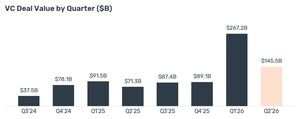
H1 2026 venture deal value hit $412.7 billion, already 29% above all of 2025's $319.2 billion, but the concentration behind that number is extreme. Megadeals ($100 million and up) made up 87.5% of dollars deployed, while deals under $100 million drew just $51.4 billion, their share of total value compressing from 43.8% in 2024 to 33.1% in 2025 to a mere 12.5% year-to-date. AI captured $355.9 billion of the $412.7 billion deployed, 86% of every venture dollar in the period. Q2 alone produced seven rounds of $1 billion or more (Anthropic, Prometheus Industries, Anduril Industries, Baseten, MiRus, Kalshi, and Cognition) totaling $87.2 billion, five of them AI companies. Anthropic's own $65 billion round marked a 157.1% pre-money step up in three months, lifting its valuation to $900 billion.
SpaceX Rewrites the Exit Playbook
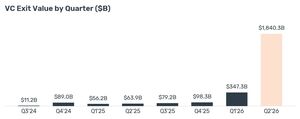
2026 is already a record-breaking year for exits, with H1 exit value of $2,187.6 billion dwarfing every full year of the past decade. Nearly all of it traces to one company. SpaceX's Q2 IPO alone generated more value than all exits in the past decade combined, raising $75 billion and pushing its market capitalization above $2 trillion in early trading. Add Q1's $250 billion acquisition of xAI (the largest VC-backed acquisition on record) and Q2's $60 billion all stock acquisition of Cursor, and SpaceX accounts for most of the headline number by itself. Strip it out, and the underlying exit environment looks a lot closer to the constrained market of recent years. The IPO window is cracking open, but narrowly: Cerebras' $34.3 billion listing raised $1 billion at five times its valuation of a year earlier, then slid below its offer price within weeks. Of the ten largest US tech IPOs this year, excluding Cerebras and SpaceX, only three have posted positive first-year returns.
Fund Formation Concentrates at the Top
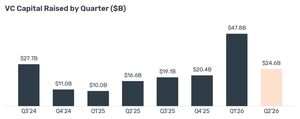
Q1 already signaled where this was headed: 172 funds closed, raising $47.8 billion for an average fund size of $278 million, the highest quarterly average in over a year. Q2 confirmed the divide rather than reversed it: fund count climbed to 233, but capital raised fell to $24.6 billion, pulling the quarterly average back down to $106 million even as the very largest vehicles kept getting bigger. H1 2026 capital raised overall reached $72.4 billion across just 405 funds, nearly matching all of 2025's $74.9 billion raised across a meaningfully larger number of vehicles. Funds of $1 billion or more raised $49.5 billion across 16 vehicles in H1 alone, already ahead of the full 2025 total of $27.5 billion across 13. Three firms (Andreessen Horowitz with $14.2 billion across seven funds, Thrive Capital with $10.0 billion across two, and Founders Fund with $10.6 billion across two) together raised $34.8 billion, 48.1% of all H1 2026 venture capital. For emerging and mid-sized managers, that means an increasingly narrow lane: LPs are paying up for scale, and everyone else is competing for what's left.
The Unrealized Trillions
Active unicorn count hit a record 945, up 9.4% from year end 2025, with aggregate unicorn valuation now standing at $5.3 trillion. But distributions to LPs remain deeply negative, down $196.9 billion since 2022, and this year's record exit value sits overwhelmingly in one newly public company, meaning it has yet to reach the broader base of funds. Until the IPO window broadens beyond a handful of AI, space, and crypto names, the gap between paper value and realized liquidity will keep widening.
Conclusion: Concentration Is the Story, Not the Aberration
Q2 2026 didn't just extend 2025's trends: it intensified them. Every pillar of the market, dealmaking, exits, and fundraising, now runs through a small number of extraordinarily large positions. That isn't inherently fragile: capital is flowing to real technological progress, and SpaceX's listing proves the public markets can still absorb scale. But it does mean the venture ecosystem's health is increasingly a bet on a handful of outcomes rather than a broad based recovery.
Key questions for Q3:
- Does OpenAI's or xAI's next move toward public markets confirm the IPO window is genuinely reopening, or was SpaceX a one-off?
- Can distributions broaden beyond the mega-exits, or will LPs keep waiting on a narrow set of outcomes?
- Does fund formation outside the top three or four firms show any signs of life?
At V17 Advisors, we help venture managers build the operational and reporting infrastructure to compete in a market where scale keeps winning, from fund administration and investor reporting to compliance programs built for institutional LPs.
Reach out if you want to be ready for whatever Q3 brings.