
Q4 2025: Fewer Funds, Bigger Bets
Dealmaking Extends Its Recovery
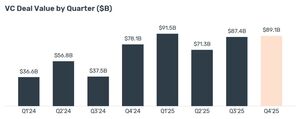
VC firms deployed $89.1 billion across roughly 4,482 deals in Q4 2025, capping a year in which quarterly deal value materially exceeded pre-pandemic levels and trailed only 2021 on a full year basis at $339.4 billion. Momentum was sustained by later stage activity: late stage VC deal value rose 45.4% year-over-year, and venture growth deal value rose 131.1%. A small number of outsized transactions, particularly in AI and other policy favored sectors, captured a disproportionate share of that capital. Corporate venture capital also played a larger role than in years past: deals with CVC participation totaled $196.7 billion for the year, the highest level of the past decade, as corporates lean on parent-company balance sheets to participate in large AI rounds.
Exits Improve, But the Liquidity Gap Persists
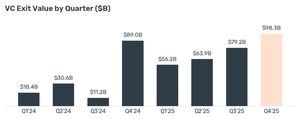
Q4 closed out 2025 with 483 exits worth $98.3 billion, bringing the full-year total to $297.6 billion across roughly 1,635 exits, the fourth highest exit value of the past decade, behind only 2019, 2020, and 2021. Seventeen unicorns went public over the course of the year, part of 48 total listings, with the largest sharing a common thread: alignment with current policy priorities in AI, space, crypto, fintech, and national security. The GENIUS Act's passage renewed investor interest in crypto and helped drive listings from stable coin issuer Circle and crypto exchange Gemini Space Station. Even so, the market still needs considerably more large exits to close the liquidity gap: unicorn valuations have grown more than sixfold since 2019, but the windfalls remain too few and far between.
Fewest Funds Close in a Decade
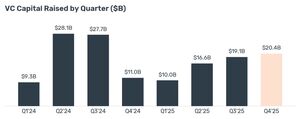
Fundraising did not pick up over the course of the year, closing 2025 at $66.1 billion in commitments across just 537 funds, the fewest funds to close in a decade. Q4 alone contributed $20.4 billion across 161 funds. The median step up required for a fund to close in 2025 was just 24.6%, the second-lowest figure of the past decade, reflecting how much harder GPs are having to work to get vehicles across the finish line. There is a genuine bright spot, though: distributions from recent IPOs are expected to boost cash flows back to LPs over the first few months of 2026, and the outlook for liquidity looks considerably brighter than it has in years.
AI's Market Value Now Rivals the Entire Rest of the Industry
AI and machine learning companies now account for $3.3 trillion in aggregate market value, just behind SaaS's $3.6 trillion and dwarfing every other vertical PitchBook tracks: Big Data, in third place, sits at $1.6 trillion. Yet the picture beneath that headline number is more fragile than it looks: 41% of all unicorns haven't raised a VC deal since at least 2022, and net cash flows to LPs have been negative $196.9 billion since that same year. More than $90 billion in dry powder still sits in 2021 and 2022 vintage funds, and $166 billion more sits in vintages between two and five years old, a substantial overhang that will need real liquidity events, not just paper valuations, to work through.
Conclusion: 2025 Closes as a Market of Extremes
2025 will be remembered as a year when venture's headline numbers looked healthy: record AI valuations, a fourth highest exit year, deal value exceeding pre-pandemic levels, while the underlying market told a more cautious story: the fewest funds closing in a decade, persistent negative cash flows to LPs, and a liquidity gap that hasn't meaningfully closed. Heading into 2026, the central question isn't whether AI keeps driving the numbers; it's whether the rest of the market, from emerging managers to mid-market exits, finds any real relief.
Key questions for Q1:
- Does the expected pickup in LP distributions from recent IPOs translate into fresh fund commitments in Q1?
- Can dealmaking outside AI and other policy-favored sectors find its footing?
- Does 2026 open with the same capital concentration, or does the market broaden?
For fund managers and allocators, the current environment calls for sharp positioning, operational resilience, and investor-ready infrastructure.
At V17 Advisors, we help venture managers navigate exactly this kind of environment, one where headline strength and underlying fragility coexist, and where LPs are asking harder questions than the top-line numbers might suggest.
Reach out if you want to talk through how 2026 is shaping up for your fund.